



























Changing your HVAC filter should be second nature. But have you thought about how the MERV rating you choose affects your home?
MERV stands for Minimum Efficiency Reporting Value. The MERV rating system is the industry standard the American Society of Heating, Refrigerating, and Air Conditioning Engineers (ASHRAE) created. It is used to compare filters made by various manufacturers. MERV ratings range from 1 (low efficiency; minimum filtration) to 20 (highest efficiency; highest filtration).
- MERV ratings range from 1 (low filtration) to 20 (highest filtration), indicating a filter's particle-capturing ability.
- MERV 11 filters are ideal for homes, improving air quality and handling pet dander better than MERV 8.
- Higher MERV ratings like 13+ reduce airflow, potentially straining HVAC systems and increasing energy costs.
- Filters should be changed every 1-3 months, more often with pets, allergies, or poor local air quality.
- MERV 11 filters cost more but offer better filtration; buying in bulk can lower expenses.
Air Filter Types and Recommendations
If you use cheap air filters like fiberglass ones in your home, you could be doing more harm than good. Unfortunately, fiberglass air filters are not as effective at capturing airborne contaminants.
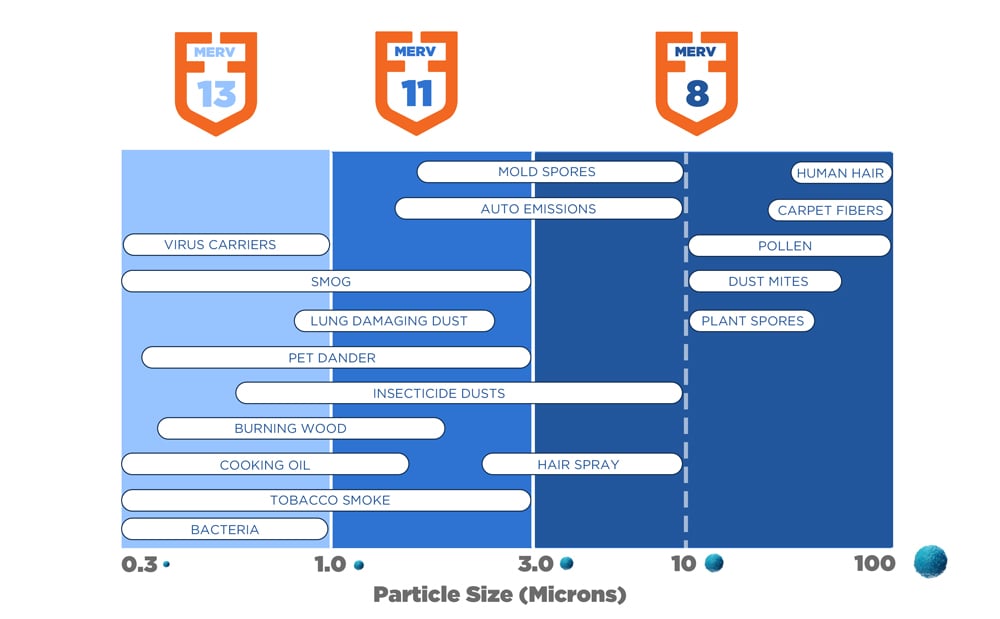
MERV 8 or MERV 11 filters are the most recommended for most households. The highest MERV rating that can be used in the average home is MERV 13. An easy way to remember MERV ratings is that the higher the MERV rating, the smaller the particles it can capture.
According to Alex, our in-house air filtration expert, MERV 11 air filters are ideal.
“The MERV 11 air filters remove a higher percentage of contaminants in the air that will increase indoor air quality and maintain the efficiency of the HVAC unit. It is also highly recommended if there are pets in the home, which can greatly reduce the air quality in your home.”
Any MERV past 13 is considered HEPA. HEPA stands for High-Efficiency Particulate Air, and HEPA filters are certified to reduce contaminants as small as 0.3 microns. This type of filter requires a specialty system and is often only used in hospitals and laboratories. HEPA filters are not recommended for residential applications.
Importance of Airflow
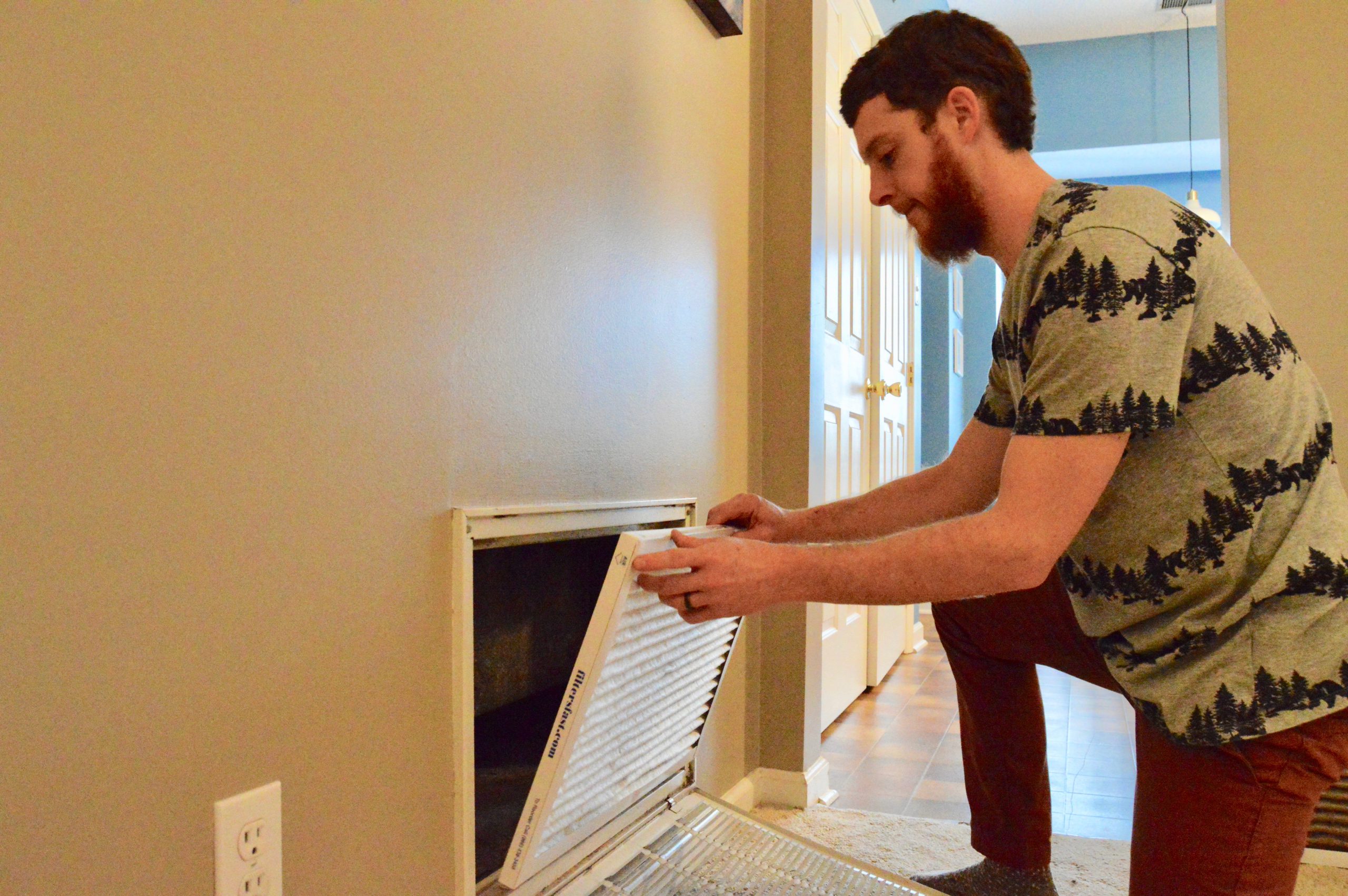
While having a filter that can capture finer particles may be ideal, you must also consider how a higher MERV filter will impact your airflow.
Why is considering airflow so important when selecting the right furnace filter? For example, MERV 13 air filters will reduce the tinier particles in your home’s air and minimize the airflow through your system. This can strain your furnace and HVAC system, costing you money to repair and increase your monthly energy bill.
However, it’s important to note that any MERV rating above 13 could negatively affect some HVAC systems, so it’s advisable to verify that your unit can handle higher-rated filters before purchasing.
The chart below shows the particle sizes each MERV rating can capture.
MERV 8 vs MERV 11: HVAC Efficiency
When considering which MERV rating best suits your needs, you must understand how MERV ratings can impact your HVAC system’s efficiency.
MERV 8: Captures larger particles, like dust, pollen, and mold spores, helping to protect your heating and cooling system and improve indoor air quality. It also allows for better airflow and reduces the system’s strain, often resulting in lower energy consumption. These same airflow and efficiency considerations apply when selecting AC filters for a cooling system.
MERV 11: capture finer particles, including pet dander and smoke, providing higher air purification. While they filter more effectively, they’re also denser, which will impact airflow. This is why ensuring that your HVAC system is equipped to handle a higher level of filtration is crucial. If not, it may work harder to pull air through the filter. If you choose not to, you may see an increase in energy usage, leading to higher utility bills.
Ultimately, you should ensure that your MERV is adequate for your system’s capabilities and requirements.
MERV 8 vs MERV 11: Maintenance
Air filters should be replaced at least every 1-3 months to ensure efficiency. However, several factors may lead to more frequent filter changes.
These factors may include:
- Number of people living in your home
- Number of pets living in your home
- If a smoker lives in your home
- The climate where you live
- Local air quality
- If someone with allergies lives in your home
MERV 11 air filters may require frequent changes due to their tighter-knit media and ability to capture smaller particles.
As a rule of thumb, it’s a good idea to check your air filter every few weeks and change it when it needs to be replaced.
MERV 8 vs MERV 11: Cost
Cost is something to consider when shopping for air filters.
MERV 8 Filters: Budget-friendly and will provide an adequate amount of filtration.
MERV 11 Filters: More expensive due to their premium filtration capability.
Buying in bulk is an easy way to save money on air filters. Most businesses will give a bulk discount if you purchase multiple filters. Plus, you’ll have filters on hand for future filter changes.
Your Trusted Filter Source
Filters Fast carries a wide selection of high-quality, pleated air filters for your home with various MERV ratings. We also have air filters in 1-in., 2-in., 3-in., and 4-in. depths, as well as 5-inch air filters for compatible systems.
However, our Filters Fast® Brand MERV 11 air filters are better for your home. These filters have been rigorously tested to ensure that they meet quality standards and are guaranteed to effectively reduce dust mites, pollen, pet dander, and other allergens from your indoor air.
Invest in a quality filter for your furnace without paying a high price.
Ensure you verify the size you need and place your order. Wondering how to figure out what size furnace filter you need? Check out this video:
Looking for an easier way to stay on top of changing your home’s filters? Our Home Filter Club filter subscription service offers free shipping and up to 10% off every order. Our convenient filter subscription provides the convenience of having replacement air and other home filters sent to your home at the frequency that works best for you.
The Filters Fast® Brand MERV 11 furnace filters are a better option for your home than MERV 8 and lower filters. It’s essential to know the MERV rating you are getting and what it will filter out from your air.
While selecting the right furnace filter for your home is important, changing it regularly is just as important. Remember, for best results, it is recommended that you replace your air filter every 1-3 months.
Have a question about finding the right HVAC filter for your furnace? We’re happy to help.Give us at a call at 866-438-3458 or email us at [email protected].
Related blogs:
- What’s the Difference Between FPR, MERV and MPR?
- An In-Depth MERV Ratings Guide: Must Read Before You Buy!
- Is a MERV 11 Furnace Filter Right for Your System?


Katie says
Chin,
Thank you for reaching out to us. According to the EPA, the PM number is a reference to a particle size; micrometer or micron as it’s more commonly known in air filter parlance. MERV 11 filters can filter particles as small as 0.3 micron or PM0.3. Note, with poor air quality more frequent filter changes will be needed. Also, as doors and windows are opened and closed that too will introduce more of that particulate matter.
https://www.epa.gov/pm-pollution/particulate-matter-pm-basics
Chin Ma says
Because of the recent California fire, the PM2.5 number at our area is 250 according to http://www.purpleair.com; will MERV 11 AC filter be able to reduce the number to 20 inside our house?
Katie says
Ralph,
A MERV 15 Air Filters will remove 85-95% of particles the size of 0.3-1.0 microns. We do not have enough information to confirm that a MERV 15 will remove coronavirus. MERV 15 filters are not recommended for residential application. Please consult with a HVAC professional to find out what MERV rating your system is equipped to handle.
RALPH DiGENNARO says
will a merv 15 filter remove caronaviris
Katie says
Allison,
We’re glad you learned something from reading our blog! We would recommend consulting a heating an air professional to make sure your system can handle MERV 11.
Allison says
Thanks for the info. I have always used a lesser MERV rated filter and just changed it allot. I just built a new house and have no carpet, one cat that mostly stays outside so not much hair. I think I am going to pull the trigger on two K&N filters that are re-useable like the car & truck air filters. They say they are MERV 11 so hopefully my new AC units will be fine with that rating.
Katie says
Hi Kathie,
That is a great question! It is recommended that you change your air filter every 1-3 months. How often you change it is completely up to you. There are many factors as to why you would need to change it more frequently. A couple of reasons for needing to changing it more frequently could be if you have pets, an older home, or people in your home suffer from allergies. We would recommend checking it every once in a while and changing as often as works for you.
Kathie Hardin says
how often should you change the merv 11 filters ?
Katie says
A Asthana,
We have many blog posts about the difference between different MERVs. Here’s one that explains the differences between different ratings scales and talks about the efficiency of different MERVs. https://www.filtersfast.com/blog/merv-mpr-and-fpr-ratings-explained/
Please let us know if you have any additional questions.
A Asthana says
What is the REAL difference between MERV 13 and MERV 12? I can’t find MERV-13 which I currently use and am worried about a lower efficiency level of particulate removal
Katie says
DEMET,
Please email [email protected] and they can help you with this quote.
Thanks!
DEMET GUCLU says
Hello ,
Can you submit a quote for the below items.
001 AIR FILTER 24″ X 24″ X 4″, MERV-11,P# 855148004, CAMFIL 100 EA
002 AIR FILTER,24″x24″x12″,P#DU4V1511/DU4VES2424/855080-008,MERV13, CAMFIL 600 EA
Shipping Information
City State Zip Code
NORTH BRUNSWICK NJ 08902
Katie says
Charmaine,
Thank you for reaching out to us. We would recommend reaching out to the manufacturer of your unit to confirm whether MERV 13 is compatible. If you do not feel comfortable using these, please initiate a return.
Charmaine says
Hi…I’m not sure if I screwed up or not. From what I can tell, merv 11 is recommended for our Goodman furnace . I ordered merv 13 after reading what it filters out. Now I’m worried that the furnace will be working too hard with the 13. Should I return the 13’s for 11’s?
BLazy says
Hello Barbara,
Switching to a Merv 8 or 11 will be cheaper to replace and may save on energy but I believe you would need a dual zoned hvac system (an additional thermostat placed upstairs) to acheive the comfort levels you desire on both floors at the same time. I have a similar dilemma but can’t afford the upgrade. Instead I chose to supplement the upstairs with a window ac unit and infrared heater. Hope this helps!
Kory says
Hello Barbara,
A MERV 14 may be too restrictive on the air flow, it is definitely a possibility. Do you have pets or smoke in your home? If not, you could measure down to a MERV 8 or a MERV 11 and see if that helps with the air flow.
Barbara says
Our home is 5 years old and our HVAC System is an Amana. It came with a MERV 14 filter and we have always used that size when replacing it. I have a 2 story home and only 1 zone (a Schell Home). I do find that it is very difficult getting the right amount of heat or AC upstairs. We have to turn up or down the thermostat downstairs in order to cool or heat upstairs which can be annoying as we either freeze or are too hot downstairs. Anyway, I have heard from other comments that this size filter can restrict airflow. Is this true? And maybe we should use a different size in order to get the flow correct upstairs?
Catharine says
I had switched from a merv 11 to an 8 and I started sneezing all the time. I had been using the 8 for about 4 months and we were all getting sick due the mold and bacteria. There was more dust that settled. I switched because it was a little cheaper but I always buy my filters from a supplier not places like Home Depot or Lowes. They are way over priced. A lot of the A/C companies buy them their then charge you double. They don’t care over merv 8 so I buy them direct from the distributor right to my door. I will never switch back.
Gregory Clark, PE says
Most furnance motors are sized to handle a Merv 11 with a properly sized duct system. A Merv 13 in some cases might be too much restriction of air flow. You can check with the manufacturer but your duct sizing is part of the equation and they really can’t answer the question without knowing the duct layout. Older duct layouts depend on what type of furnace they were sized for orginally.
Joel Lantz says
In response to Julie Billow’s 10/26/14 question, larger-Merv-number filters remove everything that smaller-Merv-number filters remove PLUS smaller particles that smaller-Merv-number filters CANNOT remove.
For example, a Merv 11 filter, having smaller pores than a Merv 8, removes all the bigger particles that a larger-pore Merv 8 filter removes AS WELL AS the smaller particles that only a Merv 11 filter can remove. A Merv 13 filter, having yet smaller pores, removes all the bigger particles that a Merv 11 filter removes AND all the still-bigger particles that a Merv 8 removes — AS WELL AS yet-smaller particles that only a Merv 13 filter can remove.
brian says
Merv 8 will give you a lower electric bill than merv 11. Less air can blow through an 11 or 13 which makes your unit work run longer to cool or heat a room to the desired temp.
Kory says
MERV 8 would be a great choice, especially if you are concerned about air flow restriction. Merv 8 will provide adequate filtration by removing 17.1% of particles that are 0.3-1 micron, 47% of particles that are 1-3 microns and 70.3% of particles that are 3-10 microns.
Kory says
The chart is giving a range of particles sizes that each contaminant is. For example, a mold spore can range from 2 microns to 10 microns and some of this contaminant will be removed by MERV 8 and MERV 11 will remove all of the mold spores. The MERV 13 removes even smaller particles and will remove all of the mold spores as well.
Kory says
Hi Roger, it seems like the manual doesn’t come with a recommended MERV Rating. Most homes should use either a MERV 8 or a MERV 11 air filter. The MERV 11 will give you more efficiency in capturing airborne particles.
Russell Kiel says
I would like to use the highest rated Merv rating that I can like the Merv 11 that you talk about, but I have an old house with 5″ round heating ducts and concerned with too much rescriction. I do have a brand new furnace and was thinking maybe going with Merv 8?? What do you guys think?? Thanks for any information on this.
Russ
roger w. riddell says
what merv rated air filter is recommended for a trane xv95 natural gas furnance? thanks
Julie Bilow says
Well, I have looked at your chart and my question is
According to the chart, a 13 or 11 doesn’t do ALL of what an 8 does.
To me it would seem logical that the higher ratings would cover all the 8 does and a 13 would also cover the 8 and 11.
Wouldn’t 11 and 13 also filter pollen, dust mites, and plant spores?
Can you explain this to me?
Thanks
Julie