



























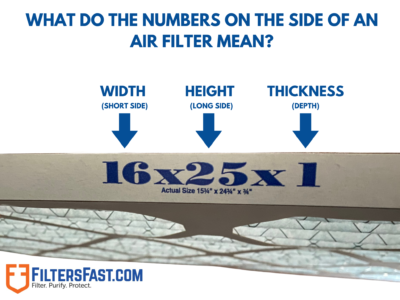
What do the numbers on an air filter stand for? It indicates the size of your filter.
When reading the numbers left to right, the first number will be the width or short side of the filter, the middle number will be the height or long side of the filter, and the last number will be the thickness or depth of the filter.
Understanding Air Filter Sizing
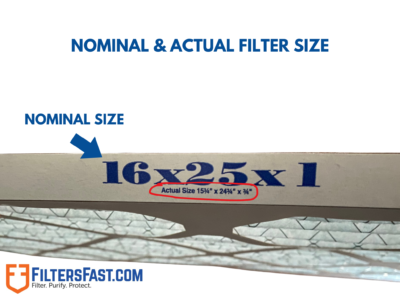
Air filter sizing, it’s not as exact as you might think. When you measure your filter, you might find that the size is slightly different than the sizes you see available in-store or online. When it comes to air filter measurements, here are the two measurements you’ll see:
- Actual measurement: This is the exact size of the filter. You may notice that ¾ and ½ inches are included when measuring your filter.
- Nominal measurement: The measurement of your filter rounded to the nearest number. Remember that actual measurement you have? Round those numbers up to the closest number, the size you will need. When shopping for air filters, you will see the nominal size listed. This is the measurement you need to know.
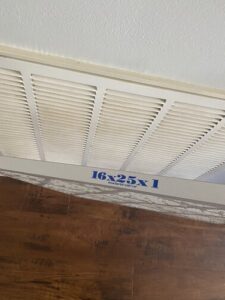
Upon further inspection of your filter, the actual measurement is printed on the frame, as seen in the picture below.
Why Air Filter Sizing is Important
Unfortunately, air filter sizes are not one size fits all. While some sizes are more common than others, each home and business’s air filter sizing needs can be very different. Using an incorrectly sized filter can lead to multiple issues.
If a filter is too small, contaminants can bypass it and find their way into your HVAC system’s vital cogs and coils, leading to higher energy bills and even system failure.
If a filter is too large, it can limit airflow, which will cause your system to work harder to heat and cool your home. This will tire out your system quicker, which can lead to costly repairs or even replacements.
Using an air filter that is not the proper size can negatively affect your HVAC’s performance, shorten the system’s life, and increase your energy bill. It can also impact your home’s indoor air quality, leading to chronic health issues.
In addition to system and air quality issues, incorrectly sized filters can damage the filter, cause excess noise, or need to be replaced more frequently.
Taking a little more time to ensure you have the correct size air filter will benefit you in the long term.
Does the size of the air filter you use matter?
Yes, the filter size you use does matter. Using an improperly sized filter will cost you more in the long run.
If you find the filter you bought is too big, NEVER cut it to fit. Tampering with a filter will hinder it from doing its job and cause system failure, inefficiency, and poor air quality.
If you find that you bought the wrong size filter or if you purchased it from Filters Fast, you don’t need to worry! We offer a 365-day satisfaction guarantee for most products, so you can quickly return your filter for the correct size. Contact our Customer Support Team at 866-438-3458.
Can’t find your filter size? Order a custom-sized air filter.
Other Things to Consider When Purchasing an Air Filter
Quality
Equally as important as using the correct sized filter is which MERV rating you choose. MERV stands for Minimum Efficiency Reporting Value and is the industry standard for rating the effectiveness of a filter. This rating system was created by the American Society of Heating, Refrigerating, and Air Conditioning Engineers (ASHRAE). To learn more about MERV Ratings, check out our blog, An In-Depth MERV Ratings Guide: Must-Read Before You Buy!
Other air filter ratings you may encounter when shopping for HVAC filters are the Micro particle Performance Rating (MPR) and the Filter Performance Rating (FPR).
- MPR ratings are used exclusively by 3M Filtrete.
- FPR ratings were created and used by The Home Depot.
What’s the difference? Read this blog post to find out.
MERV ratings are essential as they ensure extra protection for your air conditioner. The higher the MERV rating, the smaller the particles it will capture.
The most recommended MERVs for a home are MERV 8 and MERV 11, as they capture large particles like dust, pollen, and pet dander. The highest MERV rating for residential applications is MERV 13. This MERV will filter against finer particles like mold spores and bacteria. To figure out which MERV rating best fits your unique needs, here’s a helpful resource.
Cost
You’ll also want to consider cost when purchasing air filters for your home. Opting for a cheaper filter may cost you more money in the long run. Find a filter retailer you can trust, like Filters Fast, to ensure you get the best bang for your buck. Filters Fast® Brand Filters are made in the United States and are rigorously tested to ensure quality.
Buying them in bulk is an easy way to save money on air filters. Although buying in bulk may incur a higher upfront cost, the per-filter cost is much lower than buying individual filters. Plus, you’ll have plenty on hand for future filter changes and won’t have to run out to the store or wait until you remember to order filters again to change them.
Convenience
For the most effective results, air filters should be changed every 1-3 months. Many people avoid this household chore, but doing so can harm their system and their health. Something as simple as creating a subscription for your air filters will be something your future self will thank you for.
Filters Fast offers a convenient filter subscription program with some fantastic benefits. When you subscribe to a filter, you can get up to 10% off each order and FREE shipping on every subscription order. You’re in control. You get to choose your delivery schedule, and you can modify your order at any time! It’s a no-brainer!
Summary
We understand you don’t want to worry about remembering which filter size you need and when it can be changed. That’s where we come in! Let us help make it easy to stay on top of changing your filters!
If you have any questions, please contact us! We’re here for you. Call us at 866-438-3458 or email us at [email protected].



Leave a Reply