

























When shopping for air filters, you will encounter a variety of sizes, brands, and rating systems. Understanding the meaning of these different terms and how they relate to your specific needs is essential.
In this blog, we will define the term MERV, explain its significance, and offer guidance on how to utilize it when purchasing air filters.
What does MERV stand for?
MERV stands for Minimum Efficiency Reporting Value. This system was created by the American Society of Heating, Refrigeration, and Air-Conditioning Engineers (ASHRAE). It is the standard that rates how well air filters perform.
Do higher MERV ratings affect filter efficiency?
MERV ratings range from 1 to 20. The higher the number, the finer the filtration (fewer airborne particles can get through the filter media). The MERV rating system enables easy evaluation of an air filter’s effectiveness in trapping airborne particles. Although higher MERV ratings offer more advanced filtration for finer particles, they will also affect the pressure drop.
Pressure drop occurs when air pressure decreases as the air moves through the ductwork. This resistance can strain the HVAC system, shortening the lifespan of vital parts and the system as a whole.
Therefore, higher MERVs will be more efficient at capturing a broader range of contaminants; however, they will reduce the efficiency of your HVAC system by requiring it to work harder to pull air through the ducts. Finding the right balance between filtration performance and pressure drop is crucial to ensure your HVAC system operates optimally.
How Well Does Each MERV Capture Particles?
Shopping for air filters is all about finding the filter that best suits your needs and addresses your air quality concerns. The rating you choose depends on the size of the particles. It also depends on the percentage of air your filter can trap as it flows through. The size of microscopic particles is typically measured in microns. A micron is a unit of measurement equivalent to one-millionth of a meter. In other words, tiny.
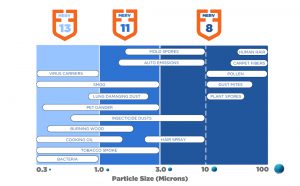
Here’s a quick look at how the different MERV ratings stack up when it comes to capturing particles of various micron sizes:
- 1-4: Will capture less than 20% of larger airborne particles like pollen, dust mites, and carpet fibers. The size particles it’s best for are the ones in the 3.0–10.0 micron range.
- 5-8: Capture between 20% and 85% of particles sized 3.0–10.0 microns, which includes items such as mold spores and pet dander.
- 9-12: Traps over 85% of larger particles, as well as some smaller particles around 1.0–3.0 microns, like auto emissions, lead dust, and flour. Filters on the higher end of this range will catch between 50% and 89% of smaller particles.
- 13-16: MERV 13 filters will capture at least 90% of particles in both the 1.0–3.0 micron and the 3.0–10.0 micron ranges— and even up to 75% or more of ultra-fine particles between 0.3–1.0 microns. That includes contaminants like bacteria, smoke, and sneeze droplets. A MERV 16 will trap up to 95% or more of those ultra-tiny particles.
In short, the higher the number, the more efficiently your filter will catch smaller and more challenging contaminants. A higher rating is best for households with individuals who have severe allergies or asthma.

What are the most recommended MERV ratings?
ASHRAE suggests using a MERV rating of 6 or higher. This helps provide basic filtration in most homes.
To meet green building standards, follow the guidelines of the Leadership in Energy and Environmental Design (LEED). LEED recommends a minimum MERV rating of 8. This will help ensure that your indoor air quality meets the baseline level of filtration.
The U.S. Department of Energy recommends using a MERV 13-rated filter. This level of filtration is considered highly effective at capturing the smallest airborne particles. It’s essential to note that this rating will restrict airflow, so it’s crucial to ensure your HVAC system is rated to handle it.
Filters Fast recommends MERV 8, MERV 11, or MERV 13 based on your specific needs. These ratings will provide adequate filtration for the most common air contaminants.
What do the different MERV values represent?
The range of numbers can be a bit overwhelming, so it’s best to keep it simple.
Most particles in the air are invisible to the eye, so we’ve listed below the contaminants that MERV 8-13 is rated to capture, to help make it a bit easier for you.
Particles MERV 8 filters will reduce particles between 3.0 and 100 microns:
- Dust
- Pollen
- Mold Spores
- Other Common Airborne Allergens
MERV 11 filters will reduce particles in the air the size of 1.0-3.0 microns:
- Dust
- Pollen
- Mold Spores
- Pet Dander
- Dust Mites
- Smoke & Smog
- Other Common Airborne Allergens
A MERV 13 filter will capture particles 0.3-1.0 microns in size:
- Dust
- Pollen
- Mold Spores
- Bacteria
- Pet Dander
- Dust Mites
- Smoke & Smog
- Virus Carriers
- Other Common Airborne Allergens
What if I can’t find the rating I need?
The majority of air filters available at stores or online will likely have the MERV rating listed on the package or in the product description. Some filter brands even have their own performance rating, too, so we recommend doing your research before purchasing.
Deciding on the right air filter rating for you and your family is easy when you have the correct information. We recommend selecting a rating based on your specific filtration needs. Think about the characteristics of your home and ask yourself these three questions:
- Do you have more than one pet?
- How old is your home?
- Do people in your family suffer from allergies?
If my MERV rating is higher, do I need to change my filter less often?
The MERV rating you choose has no bearing on how often you need to change your filter. Air filters, regardless of rating, size, or system, should be replaced every 1 to 3 months. However, we recommend checking your filter regularly and replacing it at a frequency that suits you.

The Right Rating + Filter Changing = Happy HVAC
Your HVAC system requires good airflow to work efficiently. That’s why it’s not only important to choose the right MERV rating, but it’s also essential to replace it regularly. A clogged air filter will restrict airflow, causing your unit to work harder. This will put extra strain on your system, resulting in higher energy bills and potentially costly repairs.
The key to achieving better air quality and a longer-lasting HVAC system is to replace your filters on a regular basis. Out of sight, out of mind, right? Here are a few easy ways you can set yourself up for success and make sure that you stay on top of filter changes:
- Mark it on the calendar. Choose a day per month to check or change your filter.
- Add a reminder in your phone. Easily set up a reminder to change your air filters on a schedule that works for you.
- Sign up for an air filter subscription. Filters Fast offers an excellent program where all you have to do is choose “Subscribe + Save“, set the schedule for your filter delivery, and change them when they arrive. It’s that easy! Plus, you’ll save money on shipping and even get a percentage off every order!
Need help choosing the right MERV? Feel free to leave us a comment, call us at 866-438-3458, or email us at [email protected]. We’re happy to help!
This blog post was written in partnership with the National Air Filtration Association (NAFA) because it aligns with their mission to educate end-users about the importance of air filtration. To learn more about NAFA, click here.



Brandon says
Thanks for reaching out to us. We’ll look into your request. If you have any other questions, please feel free to contact us at [email protected]. Take care!
TRiddell says
Please stop sending emails to [email protected]. I will check again next week. TRiddell