





























- Ensure the airflow arrow on the air filter points toward the furnace, wall, or ceiling to maintain proper airflow and system efficiency.
- If no arrow exists, the wire mesh side faces the HVAC unit, and the pleated side faces incoming air for correct installation.
- Change AC filters every 3 months, checking monthly during heavy use, to protect indoor air quality and extend HVAC lifespan.
Is your AC air filter installed correctly? The way you install your air filter might not seem important, but it can have a bigger impact than you think.
Quick answer: If your air filter frame has an airflow arrow, make sure it points toward the furnace, wall, or ceiling. Most pleated air filters, including many 5-inch air filters, have two sides. One has a criss-cross design, while the other side is open with visible pleats. If your filter does not have an arrow, make sure the more open side faces you or the furnace system when installing.
Why Does It Matter Which Way You Install Your Filter?
Installing a filter backward will restrict air flow, forcing your air conditioner to work harder and longer to push cool air out. This will increase wear and tear, lead to higher monthly utility bills, and even cause your HVAC system to wear out more quickly.
Watch this short video for a quick explanation:
A well-maintained HVAC unit can last 15-20 years in most climates. However, if you live in an area where you’ll need air conditioning for most of the year, like Florida, you can expect to get 8-14 years out of your unit before you need to replace it.
Why Correct AC Filter Installation is Key
Installing a filter backward will restrict air flow. This can force your air conditioning system to work harder and longer to push out cool air. This will increase wear and tear, can lead to higher monthly utility bills, and even cause your HVAC system to break down.
Why Is It Important to Know Which Way the Air Filter Goes?
First, let’s discuss why knowing how the air filter enters your system is essential. Providing your home with the highest-quality air is vital to your well-being. This means your filter must run at peak efficiency. You will need to install it correctly for this to happen.
Air filters work by trapping particles on their surface. The more particles trapped in this area, the less they will escape into your home and pollute indoor air quality.
We consider the back of the filter to be the support structure. This side usually has a metal mesh or framing. The other side of the filter is open, exposing the filter media. This side captures dangerous contaminants, so the air should contact this surface first.
If both sides of your air filter look the same, it doesn’t matter which way you install it. Fiberglass air filters usually look the same on both sides and perform the same no matter which way you install them.
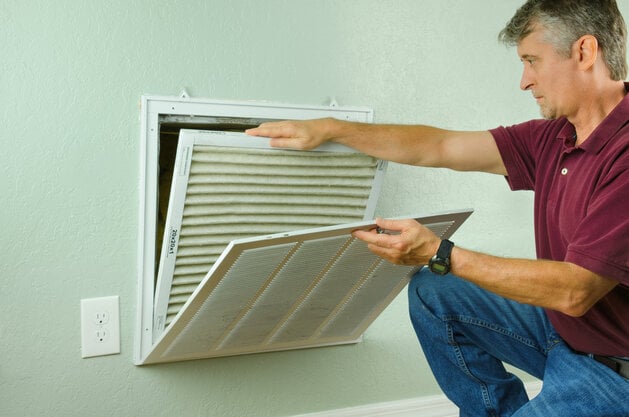
Where to Find the Airflow Arrow on Your Filter
Not sure where the airflow arrow is? This is not an industry standard, but most air filters will have this handy indicator printed somewhere along the edge of the frame. Examine the corners or the sides.
Brands like Filtrete, Honeywell, and Filters Fast have arrows printed directly on the cardboard frame. If you don’t see it right away, rotate the filter and check all sides. This simple detail takes the guesswork out of installation and keeps your system running smoothly.
Fiberglass filters usually do not have an arrow printed along the side, as they have the same design on all sides.
Which Way Does the Airflow Arrow Point?
Is there an arrow on your filter? The arrow on your filter should always point in the direction of the airflow or towards the air return.
Air filters are typically installed in one of two places. In the furnace, in the ceiling, or in the wall. Some houses may have one filter, while others might require multiple filters.
If you have an upflow furnace, the furnace filter should face up; if you have a downflow furnace, it should face down. A simple way to remember this is if the furnace’s airflow pulls air upwards, then the arrow should point upwards. The arrow must point in that direction if the airflow is pulling downwards or forward. This is an easy way to help you verify.
If your filter is in a return air vent, it will most likely be installed in a wall or ceiling with a metal grate-like cover, called a return air grille. Return air vents draw in air, which is typically where air filters are installed. These are different from air registers, which are where air comes out.
As air passes through the filter, it then flows into your heating or cooling system. When you install the filter, make sure the arrow is facing the unit, not the room. For example, if your unit is located in the attic or outside, the arrow should face toward that unit.
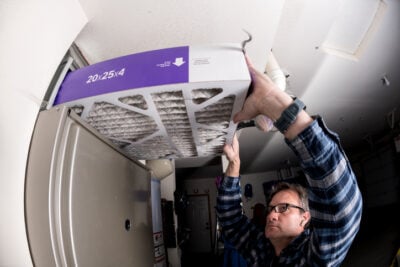
How to Position the Airflow Arrow for Wall-Mounted Filters
If your air filter is installed in a wall vent, point the airflow arrow towards the ductwork. Not sure what ductwork is? Make sure the arrow is pointed towards the wall.
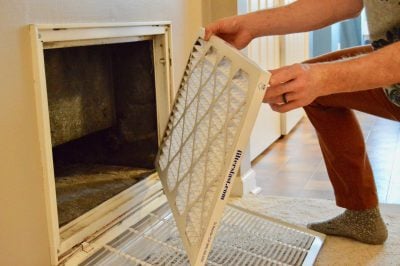
What if Your Filter is Installed in the Ceiling?
If your air filter is located in the ceiling, the airflow arrow should point towards the ceiling vent. When installing the filter, make sure the arrow is pointing towards the ceiling and not towards you.
Taking the time to double-check that your filter is installed correctly helps it capture dust and allergens more effectively. It also keeps your system running smoothly and maintains healthy air quality in your home.
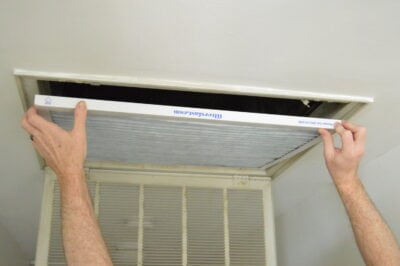
Something as simple as installing your air filter correctly and consistently will do wonders for your health and wallet.
Want to learn about more ways you can save money and cut costs?
What If Your Air Filter Doesn’t Have an Arrow?
If your air filter does not have an arrow, don’t panic! There’s still an easy way to get it right.
Look for the side of the filter with a wire mesh or cardboard support. This is the “back” of the filter. The wire-mesh side should always face the HVAC unit or air handler. The softer, pleated side should face the incoming air.
As you slide the filter into its slot, the mesh side goes deeper in, and the pleats should face you or the air return grille when you’re standing in front of it.
A quick summary:
- Wire mesh or stiff cardboard frame: Faces outward, toward you or the return vent.
- Pleated paper/media side: Faces inward, toward the air handler or furnace.
Getting this orientation right will help your system run efficiently and keep your indoor air cleaner.
It’s important to note that the above guidance applies to a pleated air filter. If your air filter looks the same on both sides, you are most likely using a fiberglass filter. Fiberglass filters typically will not have an airflow arrow. It does not matter which direction you install a fiberglass filter, as it will work as intended either way.
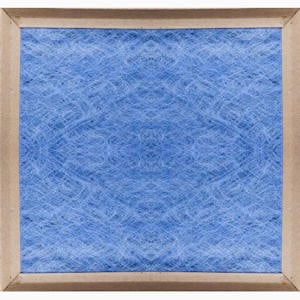
How often should you change your AC air filter, especially during the summer?
AC filters should be changed at least every 3 months to maintain the maximum benefit for your HVAC system and ensure healthy indoor air quality in your home. When choosing a replacement, select a MERV rating that your HVAC system can support.
However, it’s a good idea to get into the habit of checking your air filter every month. This is especially important during periods when your air conditioning is running frequently. Doing this will help your system run smoothly and not work too hard.
How to Never Forget to Replace Your Air Filters
The Filters Fast Home Filter Club is an air filter subscription program that delivers your filters directly to your door. All you need to do is subscribe and pick your desired delivery option, and we’ll take care of the rest!
A Simple Answer Revealed!
Changing your air filter often and knowing the right direction are essential. This helps keep your home healthy and extends the life of your home’s systems.
Remember, make sure the airflow arrow on your air filter points toward the return or furnace so it can do its job correctly. This will save you lots of money and hassle in the long run!
Do you have any other questions about air filters? Our Customer Care Team is ready to help! Contact us at 866-438-3458 or [email protected] today!


Brandon says
Hello Becky, thanks for your comment and for a bit of busy work! :). Even if the filter is inserted vertically, the airflow arrow needs to be pointing towards the furnace/AC unit. As far as the difference between the brands, you’ll want to ensure the make of the filter is quality. Which at Filters Fast, is something that we pride ourselves on. As for MERV ratings, it depends on what your use case is. For a general quick guide, MERV rating 8 – 13 are good for residential use. Anything higher can damage your HVAC system, as those levels of ratings are for commercial use like hospitals. Anything lower isn’t as effective for removing airborne particles. Here’s a visual for what type of particles the residential recommended MERVs remove. Hope that helps. Take care!
Becky says
You reference placement for installing a filter horizontally. Would you mind elaborating on a filter that is to be inserted vertically? I’m quite certain I know the answer & I’m sure it seems obvious to most but I’m also quite sure there may be some who could use clarification. 🙂 Thanks in advance! Also, of course you’re going to promote your brand & that is totally understandable. However, I’d like to know if there’s really a significant difference between the many brands available & maybe include some merv rating info as well, if possible. Yes, Google can provide this info but figured since I’m already asking questions I might as well include all of those things. Plus it gives you something to do to pass the time. 😉 Thanks in advance!
Katie says
Hi Cathy,
Thank you for your question. Our FiltersFast.com brand air filters are only available in packs of 6, but we do sell other brands in smaller packs.
Cathy says
Can I buy 2 or 3 filters instead of a whole case?