















- Compatible filters can be a cost-effective alternative if they are NSF certified and compatible with your refrigerator model.
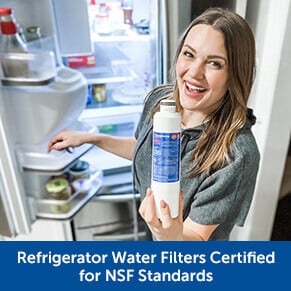
- NSF certification ensures filters meet strict safety and performance standards, with common ratings NSF 42 and 53 addressing various contaminants.
- Quality varies among aftermarket brands; trust and certification are crucial to maintaining water quality, taste, and appliance warranty rights.
You may wonder if the brand matters when shopping for replacement refrigerator water filters for your refrigerator. You will usually see various refrigerator manufacturer brands, such as GE, Whirlpool, Frigidaire, and other off-brands. The number of options available may be overwhelming. In this blog, we’ll review the differences and what you should look for when selecting a fridge replacement filter.

OEM vs Aftermarket Refrigerator Filters
Original Equipment Manufacturer (OEM) refrigerator water filters are made and sold by the same manufacturer as the original equipment. These filters are also referred to as brand name filters.
Aftermarket refrigerator water filters are designed to fit a specific refrigerator model but are made by another company or manufacturer. It is also referred to as compatible, off-brand, or generic.
There are minimal differences between OEM and aftermarket filters. Compatibility ensures that the filter will fit your appliance; you’ll also want to ensure that the filter meets your water quality and performance needs.
When deciding between an OEM filter and a compatible filter replacement, you’ll want to consider a few things:
- Quality: Quality consistency across different aftermarket brands can vary. Some compatible filters work very well, while others may fall short regarding filtration capability and durability. Here are a few questions: Can you trust the brand of compatible filter? Are you purchasing from a trusted retailer?
- Contaminant Reduction: What contaminants does the compatible filter reduce compared to the OEM filter? Does the compatible filter reduce the pollutants that you are most concerned about? A quick way to find out is to look for the NSF rating. Unfortunately, not all aftermarket filters are tested and certified.
- Price: The cost savings of purchasing a compatible filter over an OEM filter will make a difference. Remember, you’ll have to replace the filter every six months; how will the price of the refrigerator filter affect your budget?
Understanding these differences will help you make the best choice.

About NSF Certification
NSF stands for the National Sanitation Foundation. Their certification program ensures that products meet public health standards.
In order to obtain NSF certification, companies must have regular on-site inspections of manufacturing facilities and participate in re-testing of products to ensure that they continue to meet the required high standards. When a product is “NSF certified” or “NSF listed” it will display the applicable NSF certification mark to show that independent product testing organizations have tested them.
If you are considering an off-brand refrigerator filter, ensuring water purity and safety is paramount. One key thing to look for is NSF/ANSI certification. These certifications mean that the filter meets stringent standards for both safety and performance. Certified filters undergo rigorous testing to ensure that they effectively remove contaminants.
Many generic refrigerator water filters are tested to these exacting standards, meaning you don’t have to compromise on quality when opting for a more affordable option. This certification guarantees that the product complies with high industry standards and is of the utmost quality, safeguarding your health and peace of mind.
Another essential part of choosing the right filter for you and your family is being aware of the filter’s NSF rating.
Two of the most common ratings for refrigerator filters are NSF 42 and 53.
Here are the contaminants and impurities that must be filtered to achieve an NSF rating:
- NSF/ANSI 42
Filters are certified to reduce aesthetic impurities such as chlorine and taste/odor: Point-of-use (under the sink, water pitcher, etc.) or point-of-entry (whole-house) treatment systems.
- NSF/ANSI 53
Filters are certified to reduce contaminants and their health effects. Health effects are set by this standard and regulated by the U.S. Environmental Protection Agency (EPA) and Health Canada. Both standards 42 and 53 cover adsorption/filtration, which occurs when liquid, gas, or dissolved/suspended matter adheres to the surface of or in the pores of an adsorbent media. Carbon filters are an example of this type of product.
No matter, you’ll always want to ensure that the filter you buy has an NSF certification.

Do compatible filters impact water quality or taste?
If it is NSF-certified, a compatible filter adheres to industry quality standards. This means it must remove the same percentage of contaminants from your water as its OEM counterparts. If the filters hold the same NSF certifications, there should not be a significant difference in water quality, taste, or odor.
If the filter is NSF42 certified, it will reduce chlorine taste and odor. As long as the filter takes care of these aesthetic contaminants, you should not be able to tell a difference.
Is it okay to use an off-brand refrigerator filter?
It’s ultimately your choice, but it’s essential to have all the information you need to make the best choice.
Compatible refrigerator water filters are a cost-effective alternative. However, in addition to ensuring they are compatible with your device, you’ll want to ensure they meet quality and safety standards.
Will a non-OEM filter void the warranty?
There is no standard answer for whether using a compatible filter will void your fridge warranty. This can differ by manufacturer, so you should research before purchasing a filter to understand your rights as a consumer. To learn more about this topic, check out our blog “Will Non-OEM Filters Void Your Warranty?”
A Brand You Can Trust
Filters Fast® Brand Refrigerator Water Filters undergo third-party testing and proudly hold NSF certification.n. We carry a wide selection of compatible water filter replacements for top refrigerator brands. You’ll have peace of mind that you are getting your refrigerator from a brand that you can trust and that each filter is tested and certified to the highest standard. To learn more about the Filters Fast® Brand, visit our website.
Are Filters Fast Filters Good Quality?
We’re here to help provide you with the best filtration shopping experience. Have a question or want help selecting the right product for your unique needs? Call us at 866-438-3458 or email us at [email protected], and a team member will be happy to help!



Brandon says
Hello Sue, thank you for reaching out to us.
NSF/ANSI 401 is a standard that evaluates a filter’s ability to reduce certain “emerging contaminants,” including trace amounts of prescription and over-the-counter medications, pesticides, herbicides, and other chemical compounds.
Our filters are currently certified to NSF/ANSI 42 and 53, which cover the most common and impactful concerns for household drinking water, such as chlorine taste and odor, lead, and other health-related contaminants.
As for the NSF/ANSI 401 standard, we continually evaluate additional certifications based on customer needs and industry standards, and your feedback is appreciated and shared with our product team.
Please let us know if you have any other questions. We’re happy to help.
sue says
my original filter in my whirlpool side by side is everydrop edr1rxd1 (filter 1) & it has met nsf/ansi testing 42,53 & 401. I see your filters have met 42 & 53. Can you explain 401, & will your filters meet this standard in the future?
Katie says
Thanks for reading our blog and for your input!
Kory says
Hello Bruce,
What is the model number of the unit?
Thank you,
bruce flickinger says
will your Frigidaire filter fit a Samsung three door???
Kory says
Hello Rudy,
If you need to return an order, please email us at [email protected] or you may set the return up online yourself under the Contact Us page at the bottom of our website.
Thank you,
Rudy Lahnstein says
I need to return some Filters which no longer fit my new refrigerator,
What’s the pocedur in doing this?
Thank you.
Rudy Lahnstein
561-734-6998